Electronic Arts first announced Dead Space in September 2007. The game was developed at their studio in Redwood Shores California whose other titles include The Godfather and The Simpsons Game. The game's Executive Producer, Glen Schofield, said that the team aimed to create something 'darker and creepier' than their previous titles. The design team reportedly spent time analyzing a wide variety if horror films in order to find inspiration for the ingame scares.
Previews universally drew attention to the high levels of gore and violence in the game in particular the strategy of 'strategic dismemberment'. The necromorphs cannot be subdued by a single shot, rather they have to be incapacitated by shooting off their tentacles and appendages, aiming for the head or torso only serves to aggrivate some of the Necromorphs
In order to make the corpses look more realistic, the development team studied photos of car crash victims they also used this knowledge to figure out how the body parts would change once the corpse had been turned in a necromorph, such as the bone turning in scythes and the intestines becoming tentacles. The development team also studied gothic architecture when designing the Ishimura. Though the environments are futuristic, the influence of gothic architecture can be seen in the high arches and tall ceilings of the Ishimura's interior.
Thursday, 24 February 2011

Comparrison 2
Limbo is an puzzle-platformer game developed by the danish company Playdead Studios. The game is a 2D side scroller with a inovative physics system that can control the environment and that player character. Arnt Jenson, Playdead's game director, came up with the idea in 2004, he was working as a concept artist at IO Interactive at the time and had become dissatisfied with the corporate nature of the company. He had sketched a 'mood image' of a 'secret place' in order to get ideas, this resulted in something similar to the backgrounds seen in the final game. Jensen was inspired to expand on this idea. He tried to program the game on his own on Visual Basic but discovered that he needed more help and created an art style trailer by 2006. He had initially intended to use the trailer as a way of trying to recruit a programmer to help him. However the trailer got much attention from across the internet and he eventually met Dino Patti who become the co-founder of Playdead. Patti helped Jensen initially with the programming but it became clear that the project was becoming much too large for the two to handle and Patti developed the buisness around the games expanded development.
Initial development was at first funded personally by both Jensen and Patti along with Danish government grants, including those from the Nordic Game Program. Larger investors were sort later in the development cycle but Jensen and Patti did not want to commit to any major publishers as they wanted to maintain full creative control over the project. The game was initailly planed to be a free Microsoft Windows title but by this point jensen and Patti decided to make the game a retail title. Playdead chose to ignore outside advice from investors and critics alike during the development stages. Some of the advice was to add multiplayer, adjustable level difficulty and to make the game longer. However Playdead felt that by adding these options, they would be breaking the integrity of Jensen's original vision.
Numerous iterations of the game took place during a two-and-a-half year development cycle including changes that jensen had demanded to polish the title. Patti stated that they 'trashed 70%' of the content they had developed, due to it not fitting well with the context of the game. The Core development team consisted of about 8 programmers and was expanded to 16 at various stages with freelancers. The design tools for Limbo were developed in visual studio. Patti commented that they would likely seek third-third party support given the challenges in creating their own technology.
Jensen set out three goals for the final product. The first was to create a specific mood and art style. Jensen wanted to create an aesthetic for the game without resorting to 3D models and instead using a minimilistic style to allow development to focus more on the gameplay. The second goal was to only require two controls - jumpin and grabbing - outside of the normal left-and-right movement controls. This was to keep the gameplay easy. Finally the finished game was to present no tutorial to the player. The game was purposely developed to not reveal details of it's content other than the tag line. The games audio was created by Martin Stig Anderson, a graduate with specialization in acousmatic music. Anderson sought to create a non-traditional acousmatic music exclusively incorporating the sound effects of the games environments. For example; The electrical noises while in the presence of the ruined 'HOTEL' sign.
The game was designed to avoid the pitfalls of major titles where the gameplay mechanic is used repeatedly. Carlsen, initially brought onboard as a programmer for the custom game engine, became lead designer after Playdead found him capable at creating puzzles. The puzzles were designed to 'keep you guessing all the way through.' The puzzles were designed to feel like a natural part of the games environment to avoid the feeling that the player was simply moving from puzzle to puzzle thoughout the course of the game. The team developed the puzzles by first assuming the player was their 'worst enemy' and made the puzzles as devious as possible but then scaled back their difficulty or added visual and audible aids as if the player was their friend.
Playdead included gruesome death sequences to highlight incorrect solutions and discourage the players from repeating their mistakes. While they expected players to run into numerous deaths while trying solutions, Carlsen stated that their goal was to ensure death wasn't a penalty in the game and made the death animatons entertaining to keep player interested.
Initial development was at first funded personally by both Jensen and Patti along with Danish government grants, including those from the Nordic Game Program. Larger investors were sort later in the development cycle but Jensen and Patti did not want to commit to any major publishers as they wanted to maintain full creative control over the project. The game was initailly planed to be a free Microsoft Windows title but by this point jensen and Patti decided to make the game a retail title. Playdead chose to ignore outside advice from investors and critics alike during the development stages. Some of the advice was to add multiplayer, adjustable level difficulty and to make the game longer. However Playdead felt that by adding these options, they would be breaking the integrity of Jensen's original vision.
Numerous iterations of the game took place during a two-and-a-half year development cycle including changes that jensen had demanded to polish the title. Patti stated that they 'trashed 70%' of the content they had developed, due to it not fitting well with the context of the game. The Core development team consisted of about 8 programmers and was expanded to 16 at various stages with freelancers. The design tools for Limbo were developed in visual studio. Patti commented that they would likely seek third-third party support given the challenges in creating their own technology.
Jensen set out three goals for the final product. The first was to create a specific mood and art style. Jensen wanted to create an aesthetic for the game without resorting to 3D models and instead using a minimilistic style to allow development to focus more on the gameplay. The second goal was to only require two controls - jumpin and grabbing - outside of the normal left-and-right movement controls. This was to keep the gameplay easy. Finally the finished game was to present no tutorial to the player. The game was purposely developed to not reveal details of it's content other than the tag line. The games audio was created by Martin Stig Anderson, a graduate with specialization in acousmatic music. Anderson sought to create a non-traditional acousmatic music exclusively incorporating the sound effects of the games environments. For example; The electrical noises while in the presence of the ruined 'HOTEL' sign.
The game was designed to avoid the pitfalls of major titles where the gameplay mechanic is used repeatedly. Carlsen, initially brought onboard as a programmer for the custom game engine, became lead designer after Playdead found him capable at creating puzzles. The puzzles were designed to 'keep you guessing all the way through.' The puzzles were designed to feel like a natural part of the games environment to avoid the feeling that the player was simply moving from puzzle to puzzle thoughout the course of the game. The team developed the puzzles by first assuming the player was their 'worst enemy' and made the puzzles as devious as possible but then scaled back their difficulty or added visual and audible aids as if the player was their friend.
Playdead included gruesome death sequences to highlight incorrect solutions and discourage the players from repeating their mistakes. While they expected players to run into numerous deaths while trying solutions, Carlsen stated that their goal was to ensure death wasn't a penalty in the game and made the death animatons entertaining to keep player interested.
Comparrison 1
The main difference between Tale of Tales and Activision is that one is a small, independant studio while Activision is a big, comglomerate. Tale of Tales focuses more on the quality of the story, making it in depth and capable of making the player 'think' while playing the game. They focus more on this and do what they can with the software that they have, despite this they can still make beautiful and vibrant games when the situation calls for it. On the other hand Activision doesn't really focus on the story of the game much. They are more concerned with the graphics looking top notch than anything. An example of this would be Modern Warfare 2. Unlike the first one, which actually had it's good points, the game seems more of a way to make money more than anything else.
Another difference is that Tale of Tales only has two permanent employees; Auriea Harvey and Michaël Samyn. Both are skilled in many different aspects of developing games, such as concept art, 3D modelling and programing. Activision however has 4000 employees to work on a game. Activision also has a revenue of $2.9 billlion (So why are their games so expensive? they really don't need the money.) Tale of Tales on the other hand at least have an excuse to selling their short online games for $7 as they are indie and actually need the money.
(Biased much)
Another difference is that Tale of Tales only has two permanent employees; Auriea Harvey and Michaël Samyn. Both are skilled in many different aspects of developing games, such as concept art, 3D modelling and programing. Activision however has 4000 employees to work on a game. Activision also has a revenue of $2.9 billlion (So why are their games so expensive? they really don't need the money.) Tale of Tales on the other hand at least have an excuse to selling their short online games for $7 as they are indie and actually need the money.
(Biased much)
Activision

Activision is an American video game developer and publisher, majority owned by French conglomerateVivendi SA. Its current CEO and president is Bobby Kotick. It was founded on October 1, 1979 and was the world's first independent developer and distributor of video games for gaming consoles. Its first products were cartridges for the Atari 2600 video console system published from July 1980 for the US market and from August 1981 for the international market (UK). Activision is now one of the largest third party video game publishers in the world and was also the top publisher for 2007 in the United States. On January 18, 2008, Activision announced they were the top US publisher in 2007, according to the NPD Group.
On December 2, 2007, it was announced that Activision would be acquired by Vivendi, with Vivendi contributing its gaming division plus cash, in exchange for a majority stake in the new group. The merger between Activision and Vivendi Games took place on July 9, 2008, with the newly formed company known as Activision Blizzard. Activision will still exist as a subsidiary owned by Activision Blizzard, and it will still develop and publish games such as Call of Duty, along with some of Vivendi's owned IPs, such as the Crash Bandicoot and Spyro the Dragon series. As of June 15, 2010, Activision and Microsoft, specifically the Interactive Entertainment division, have an exclusive multiyear agreement; Don Mattrick announced this on June 14, 2010 during Microsoft's 2010 Electronic Entertainment Expo conference. On Feb. 9, 2011 Activision announced that it was mothballing the Guitar Hero franchise, and would no longer be developing or publishing future titles for the series.
Tale of Tales
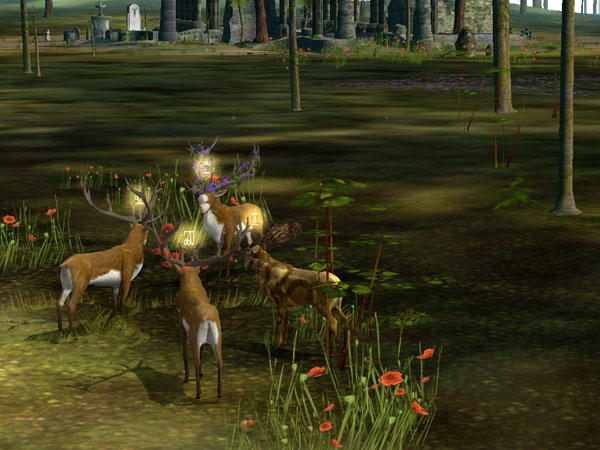
Tale of Tales BVBA is a Belgian developer of art games and screensavers founded in 2002 by Auriea Harvey (concept art, 3D modeling and texture mapping) and Michaël Samyn (interaction, effects and game programming), who had been working together in the creation of Web sites and electronic art as Entropy8Zuper! since 1999. They live very close to the Saint Bavo Cathedral, which they consider one of their greatest influences. The studio is named after Giambattista Basile's book The Tale of Tales (Lo Cunto de li cunti), with their main series being retellings of fairy tales in the form of adventure games, each subtitled "a Tale of Tales" and linked together by a common character referred to as the Deaf-Mute Girl in a Pretty White Dress in the 8 Web site and as the Girl in White in The Path's user manual. It was hinted in an interview with ZillionMonkey that their next project, following The Path, will involve the character of SalomeUnity authoring tool, which they had first trailed with The Graveyard as a side-project during development of The Path. and be developed using the
February 2010 saw the release of Vanitas, described as "a memento mori for your digital hands," their first work for the iPhone OS platform and their first with music by Zoë Keating. On March 1, 2010 it was announced that they were commencing the development of two large projects, alternating between the two of them for the next 18 months (i.e. until September 2011).
Wednesday, 2 February 2011
3D ball animation
In Maya we also made a bouncing ball animation. I found maya complicated and difficult to use and though I found it easier over time, I still find it complex. Despite this I am pleased with how the animation turned out.
I'm proud of this, but I think it could have turned out better. The squash and stretch of the ball as it falls and hits the ground doesn't look natural, but I think it's good for a first attempt.
Bouncing Ball 2D animation
Using photoshop I created two 2D animations of balls bouncing. This was the first time I had ever animated in 2D and I was pleased with the results.
The first animation was a basic bouncing ball, bouncing up and down. This was the first animation I did and I was pleased that I managed to pick it up easily. The next one is the ball bouncing in an arc, this one is my favourite.
Subscribe to:
Posts (Atom)